Intelligence
How the system learns
Stamper One ingests real world activity across satellite, maritime, industrial, and macro domains. Each observation is translated into a structured signal, validated, and fed into a system that continuously learns from real market outcomes.
Every signal becomes feedback. Every outcome improves the next decision.
Persistence
Every signal carries a measured decay
Conviction is not flat. Each reading is placed on its observed persistence curve, from day zero through the magnitude-confirmed half-life toward its conflict-fused alignment floor.
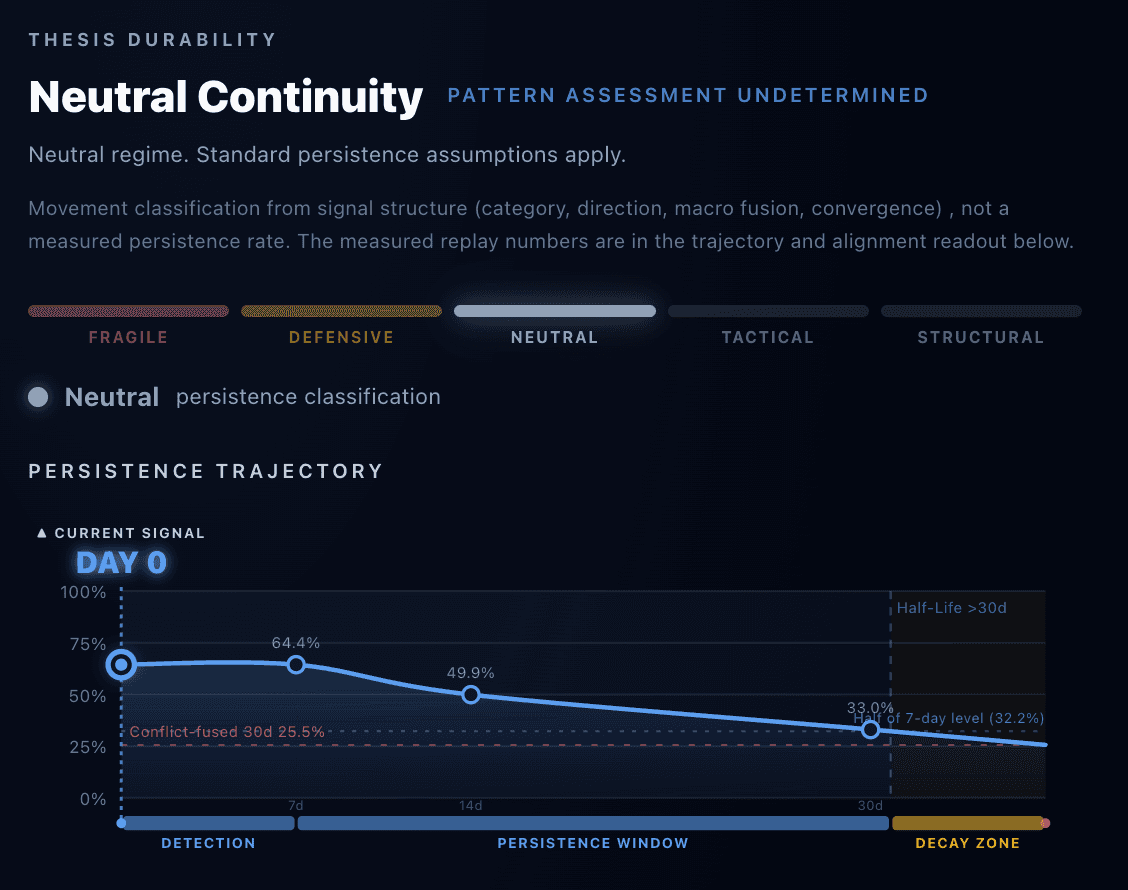
Persistence and Conviction · observed decay from day zero to half-life
Observation Layer
What the system observes
Four physical observation domains. Each contributes a distinct signal layer that the system integrates and validates continuously.
Satellite Observation
Multi spectrum observation across radar, optical, thermal, and night light data. Detects physical change before it enters reported datasets.
Maritime Intelligence
Vessel movement and port activity translated into real time throughput and trade flow signals.
Trade and Macro
Macro context layer that adjusts signal interpretation based on global trade dynamics.
Market Validation
Real market price response used to confirm, reject, and recalibrate signals.
Selected public and commercial datasets may include satellite, maritime, trade, macro, and market data sources.
Transmission
How observed reality reaches markets
Each signal is mapped to the documented path its category of change travels, from physical observation through to the parts of the market that respond.
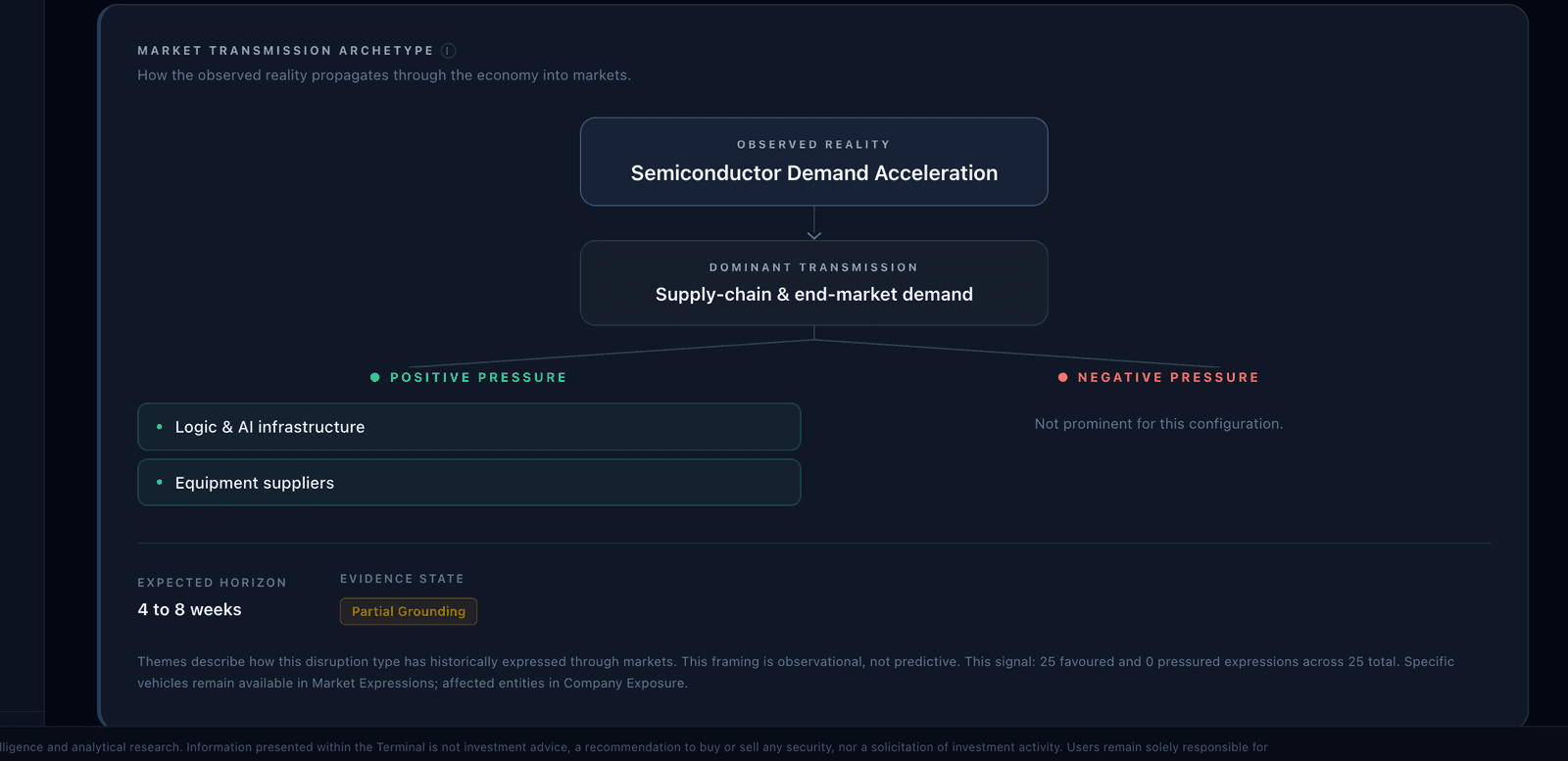
Evolution and Transmission · observed reality to market pressure
Learning Loop
The learning loop
The system does not stop at signal generation. It tracks outcomes, measures accuracy, and recalibrates continuously.
Signal formed from real world change
Physical observation quantified and structured into a directional intelligence object with confidence score.
Decision logic applied
Pattern matched. Decision output produced. Phase, conviction, and stance assigned from signal state.
Market response measured
Market response tracked against the signal prediction. Follow through measured over defined time windows.
System updated
Methods are validated against observed accuracy each cycle, and refined through deliberate revision.
The cycle never stops. Each completed loop increases system precision.
Validation
Observed, then independently confirmed
A reading advances only when independent evidence agrees, across sensors or across related zones. The ladder records observation. It is not a forecast.

Evidence and Validation · observed to independently confirmed
Intelligence Engine
How each signal is built
Each signal passes through five validation layers before reaching the user. Every step removes noise and increases conviction.
Change Detection
Each zone is evaluated against its historical baseline. Only meaningful deviations survive noise filtering and are assigned directional confidence.
Signal Assembly
Signals are structured into directional objects with magnitude, momentum, and impact scoring. Context is applied through macro and corridor relationships.
Pattern Classification
Signals are mapped into lifecycle states. The system identifies whether activity is emerging, accelerating, or fading based on historical pattern behavior. Machine learning assisted pattern recognition identifies convergence across zones and signal categories.
Micro Validation
Short term validation windows confirm or reject early signals using real observed activity. Weak signals are filtered before escalation.
Outcome Tracking
Every signal generates a prediction. Outcomes are tracked against market movement and fed back into the system to improve future accuracy.
Learning layer
Confidence is not assumed. It is earned.
The system recalibrates only based on real outcomes. Assumptions are removed. Precision compounds over time.
The system uses adaptive models to refine confidence, pattern classification, and signal interpretation based on real market outcomes.
Accuracy improves with every completed cycle.
Conviction basis
Confidence grounded in replay, not assumption
Every reading is scored against the historical replay corpus, comparable cases, magnitude-confirmed alignment, and the conflict-fused alignment floor. Confidence is earned from outcomes, never assumed.
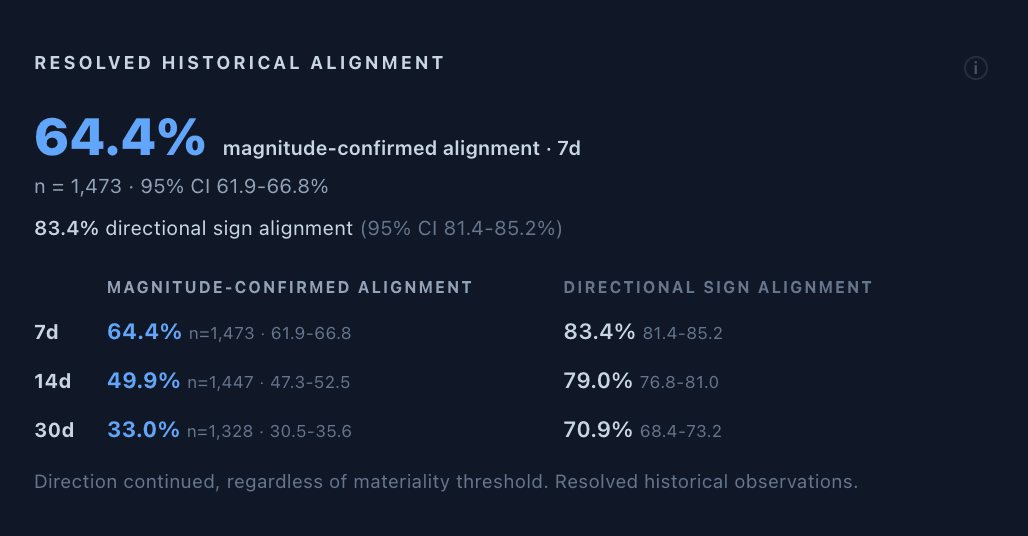
Persistence and Conviction · 13,822 prediction snapshots, replay-aligned
The longer the system runs, the stronger the edge becomes.
System Credibility
Developed by professionals with backgrounds in financial data, institutional workflows, and large scale intelligence systems.
Access